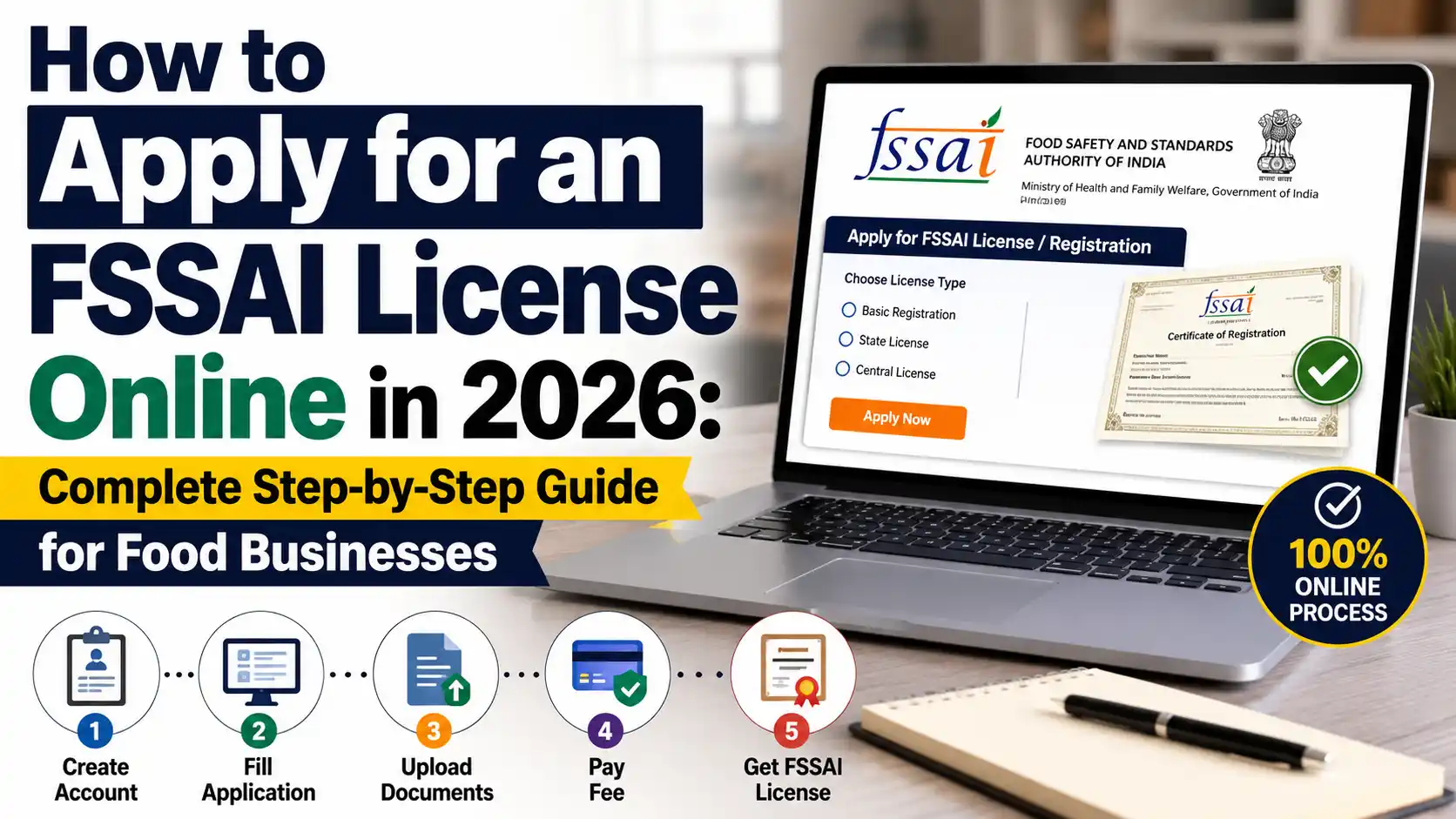
Apply for FSSAI license online in 2026 via FoSCoS. New perpetual validity rule, revised turnover limits, documents, fees & step-by-step process explained.
Quick Answer Apply for an FSSAI license on the official FoSCoS portal at foscos.fssai.gov.in. Register as a Food Business Operator, select Basic Registration, State License, or Central License based on your annual turnover, upload the required documents, pay the government fee, and submit. As of April 1, 2026, Basic Registration covers turnover up to ₹1.5 crore, State License covers ₹1.5 crore to ₹50 crore, and Central License applies above ₹50 crore. Licenses granted on or after March 10, 2026 no longer expire; they carry perpetual validity as long as fees are paid and compliance is maintained. |
Why an FSSAI License Is Non-Negotiable
Every food business in India needs an FSSAI license before it opens its doors, lists on Swiggy or Zomato, or ships its first packet of namkeen. That includes restaurants, cloud kitchens, home bakers, tiffin services, grocery stores, and food manufacturers. Section 31 of the Food Safety and Standards Act, 2006, makes this mandatory, and Section 63 sets the penalty for skipping it: up to ₹5 lakh in fines plus jail time of up to six months for serious violations.
The license is issued by the Food Safety and Standards Authority of India (FSSAI), and the paperwork now runs entirely through FoSCoS, the Food Safety Compliance System, which replaced the older FLRS portal back in 2020.
The 2026 Rule Change Nobody Can Afford to Miss
FSSAI rewrote a chunk of its licensing framework this year, and the update is bigger than most compliance tweaks. On March 10, 2026, the Gazette of India published the Food Safety and Standards (Licensing and Registration of Food Businesses) Amendment Regulations, 2026. A follow-up implementation order dated March 13, 2026 set new turnover thresholds, effective April 1, 2026.
Two changes matter most if you're applying right now:
1. Perpetual validity. Under the old rules, every license expired after one to five years and had to be renewed. That system is gone. A license or registration granted under the new regulation stays valid indefinitely, unless it's suspended, cancelled, or you surrender it yourself. You still have to pay the annual fee and file your Food Safety Compliance Return on time. Miss either one and the license gets automatically suspended.
2. Higher turnover thresholds. The old registration ceiling of ₹12 lakh is history. Here's the current picture:
| Category | Old Threshold | New Threshold (from April 1, 2026) |
| Basic Registration | Up to ₹12 lakh | Up to ₹1.5 crore |
| State License | ₹12 lakh - ₹20 crore | ₹1.5 crore - ₹50 crore |
| Central License | Above ₹20 crore | Above ₹50 crore |
If your food business was sitting in the State License bracket because your turnover crossed ₹12 lakh, there's a good chance you now qualify for the cheaper, simpler Basic Registration instead. Migration to the new category is free and doesn't change your existing license number, but it isn't automatic. You have to apply for it.
One more thing worth flagging: importers, exporters, and multi-state e-commerce food sellers still need a Central License regardless of turnover, because that requirement is based on the type of activity, not revenue.
Which License Category Applies to You
Basic Registration. Annual turnover up to ₹1.5 crore. This covers home kitchens, tiffin services, small retailers, petty food vendors, street food stalls, and food trucks. Filed using Form A.
State License. Annual turnover between ₹1.5 crore and ₹50 crore, for businesses operating within a single state. This is the bracket most restaurants, mid-sized cloud kitchens, bakeries, and single-state distributors fall into. Filed using Form B.
Central License. Annual turnover above ₹50 crore, or any business that imports/exports food, operates across multiple states, supplies to central government agencies, or runs an e-commerce food operation. Also filed using Form B, but processed by the central licensing authority.
If you're not sure which bucket you're in, the FoSCoS portal has an eligibility calculator that estimates your category once you enter your turnover and business activity.
Documents You'll Need
For Basic Registration
- Photo ID (Aadhaar or PAN) of the proprietor or partners
- Passport-size photograph
- Proof of business premises (rent agreement, electricity bill, or property papers)
- A brief description of the food business and products
For State or Central License, add
- Certificate of incorporation, partnership deed, or Memorandum of Association, depending on business structure
- PAN card and GST registration of the entity
- Layout plan of the kitchen or processing unit, showing equipment placement
- List of directors or partners with their ID proof
- Water testing report from a recognized lab (required for manufacturing or processing units)
- Food Safety Management System (FSMS) plan
- BIS license copy, if you're applying for packaged drinking water or mineral water
Scan every document as a clear, correctly labelled PDF or image before you start the online form. File-quality issues are one of the most common reasons applications bounce back.
Step-by-Step: How to Apply for FSSAI License Online
Step 1: Go to the FoSCoS portal. Open foscos.fssai.gov.in in your browser. This is the only official portal for FSSAI licensing; treat any other website asking for your documents with suspicion.
Step 2: Register as a new user. Click "Sign Up" and choose Food Business Operator (FBO). Enter your mobile number and email ID, then verify both through the OTP sent to each.
Step 3: Start a new application. Log in and select "Apply for License/Registration." The portal will ask for your state and the nature of your business.
Step 4: Pick your Kind of Business (KoB). This step decides everything that follows: your license category, the documents you'll be asked for, and the fee. Select carefully; a wrong KoB is one of the most common reasons for rejection or having to refile.
Step 5: Fill in the application form. Depending on your KoB, the system opens Form A (Basic Registration) or Form B (State/Central License). Enter your business name, address, food category, and product details exactly as they appear on your supporting documents. Even small mismatches, like a missing middle name or a different pin code, trigger a query from the licensing officer.
Step 6: Upload your documents. Attach the files in the format and size the portal specifies. Blurry scans or mismatched file names are a frequent cause of delay.
Step 7: Choose your validity period and pay the fee. You can still select a validity period of 1 to 5 years at the time of application. The perpetual validity rule applies to how long the license stays valid once issued, not to how you calculate the fee at filing. Pay through net banking, UPI, or a debit/credit card. The fee is non-refundable once submitted, so double-check the category before you pay.
Step 8: Submit and save your reference number. Once payment clears, the portal generates an application reference number. Keep it. You'll use it to track your status and respond to any queries.
Step 9: Respond to inspection or queries, if any. Basic Registration is often approved without a site visit. State and Central License applications may involve an inspection of your premises, based on the new risk-based inspection framework, which looks at your food category's risk level and your compliance history rather than applying a fixed schedule to everyone.
Step 10: Download your license. Once approved, your FSSAI certificate, with its 14-digit license number, becomes available for download from your FoSCoS dashboard. Print it and display it at your premises, and put the number on your packaging and menu as required.
How Much Does an FSSAI License Cost in 2026
| License Type | Government Fee (per year) |
| Basic Registration | ₹100 |
| State License | ₹2,000 - ₹5,000 (varies by business activity) |
| Central License | ₹7,500 |
You can pay for up to five years upfront. For Basic Registration, that works out to ₹500 total instead of paying ₹100 every year. These are government fees only; if you hire a consultant to handle the paperwork, their service charge comes on top.
How Long Does Approval Take
Basic Registration is usually the fastest, often cleared within a few working days, and small food businesses can also use the Tatkal (fast-track) option, which targets 48-hour processing after document verification and fee payment. State and Central License applications generally take 30 to 60 days, since they involve closer scrutiny and, in many cases, a premises inspection.
Common Mistakes That Get Applications Rejected
- Picking the wrong Kind of Business. This single decision drives your entire application, and correcting it later usually means starting over.
- Mismatched names. If your Aadhaar says "Rajesh Kumar Singh" and your rent agreement says "R.K. Singh," expect a clarification notice.
- Incomplete equipment or capacity details on the layout plan for manufacturing units. Officers cross-check this against your declared turnover slab.
- Blurry or oversized document scans that the portal can't process cleanly.
- Applying for a lower category than your actual turnover to save on fees. This backfires the moment your annual return shows a mismatch.
If your application does get sent back with a notice of clarification, you have 30 days to respond on your FoSCoS dashboard, and you can typically fix and resubmit documents without paying the application fee again.
What Happens If You Operate Without a License
Running a food business without a valid FSSAI license or registration is a criminal offence under the Food Safety and Standards Act, 2006, not just a paperwork lapse. Penalties can go up to ₹5 lakh, with imprisonment of up to six months for serious cases. Beyond the legal risk, most delivery aggregators and modern retail chains won't onboard a food business without a valid FSSAI number, so the license is also a practical requirement for growth, not only a legal one.
Frequently Asked Questions
Do home-based food businesses need FSSAI registration?
Yes. If you sell tiffins, pickles, snacks, or any homemade food, online or offline, you need at least Basic Registration under Section 31 of the FSS Act, 2006.
Is FSSAI license mandatory for listing on Swiggy or Zomato?
Yes. Every food delivery platform requires a valid FSSAI license number before it will list your business.
What is the Tatkal FSSAI registration option?
It's a fast-track facility on FoSCoS for Basic Registration, aimed at 48-hour processing once your documents and fee are in order. It's available to most small food businesses, though it isn't guaranteed for every category.
Do I need to renew my FSSAI license after 2026?
Not if it's issued on or after March 10, 2026. Those licenses carry perpetual validity. You still need to pay the annual fee and file your compliance return on time to avoid automatic suspension.
My turnover is ₹80 lakh. Which license do I need now?
Under the revised thresholds, anything up to ₹1.5 crore falls under Basic Registration, so ₹80 lakh turnover qualifies for the simpler registration rather than a State License.
Can I upgrade or downgrade my FSSAI category if my turnover changes?
Yes. You can apply for a modification on the FoSCoS portal when your turnover moves you into a different bracket. Migration due to the 2026 threshold changes doesn't require a fresh application fee, but a genuine change in your business scale is treated as a standard modification.
How long is an FSSAI license valid if it was issued before March 2026?
Older licenses keep running on their original validity period until their next renewal cycle, at which point they convert to perpetual validity without any extra charge.
Related Reading on LegalPehchan.com
For more compliance guidance on business licensing and regulatory topics, browse LegalPehchan.com.
Source and Verification
This guide reflects FSSAI regulations, fee structures, and the March 2026 amendment as understood at the time of writing. Rules and thresholds can change. Always cross-check current requirements on foscos.fssai.gov.in before you apply, or consult a compliance professional for business-specific advice.
About the Author
PPSingh is the Founder and CEO of Talkaaj Media, which publishes Talkaaj.com, LegalPehchan.com, and Deshtak.com. LegalPehchan.com covers legal, tax, and regulatory compliance topics for Indian businesses, including licensing, GST, and government scheme guidance.