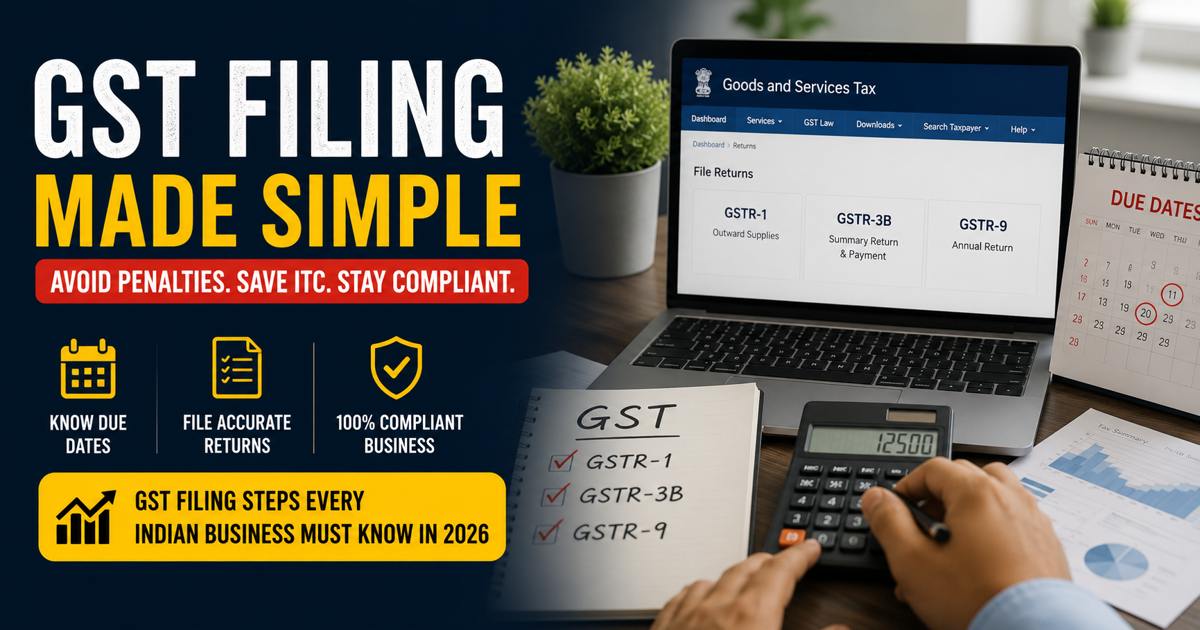
Learn the complete GST filing process for Indian businesses in 2026. Avoid late fees, claim maximum ITC, understand GSTR-1, GSTR-3B & QRMP rules, and file GST returns accurately on time.
GST Filing Steps Every Indian Business Must Know in 2026
Introduction
Over 1.4 crore GST-registered businesses in India missed at least one return deadline last year and each one paid for it. The late fee alone can run into thousands of rupees per month, per return. Yet the bigger cost is not the penalty. It is the blocked Input Tax Credit (ITC), the compliance notices, and the hours spent untangling errors that should never have happened.
If you are a small business owner, freelancer, shopkeeper, or startup founder, you already know this pain. GST filing feels like it was designed by someone who has never actually run a business. The GSTN portal times out. The terminology shifts. The due dates change. And one wrong entry in your GSTR-1 can cascade into a reconciliation nightmare months later.
In this guide you will discover exactly which returns you need to file, when to file them, how to avoid the most common errors, and how to use Input Tax Credit correctly without wading through government circulars or paying for advice you do not need yet.
Legalpehchan Tax Experts have helped over 1,000 businesses across India complete accurate GST filing and compliance. Everything in this article comes from that hands-on experience, not from theory.
Let us start with the one question most business owners ask first.
What Is GST Filing and Why Does It Matter for Your Business?
GST filing is not just a legal formality. It is the mechanism by which your business communicates with the government about every rupee of tax collected and paid. Get it wrong, and the consequences compound fast.
The Goods and Services Tax Act, 2017, administered by the Central Board of Indirect Taxes and Customs (CBIC), requires every registered taxpayer to file periodic returns that declare outward supplies, inward supplies, and the net tax payable. Missing or incorrect filings freeze your ability to claim ITC which is, for most businesses, a significant chunk of working capital.
GST filing is the process of submitting sales, purchase, and tax payment details to the GSTN portal. It works by matching your declared outward supplies with your suppliers' data. Businesses use it to claim Input Tax Credit and discharge GST liability. Over 1.38 crore returns are filed every month in India (GSTN Annual Report, 2024–25).
A clothing retailer in Jaipur we worked with had ₹2.3 lakh in ITC sitting unclaimed for six months simply because their GSTR-1 was filed after the 11th of each month. Their supplier's invoices were not reflecting in GSTR-2B on time, making ITC invisible until the next cycle. Filing on time, every time, is a direct cash-flow decision.
Definitive statement: Timely GST filing is the single most effective action a registered business can take to protect its Input Tax Credit and avoid compounding late fees under Section 47 of the CGST Act, 2017.
Which GST Returns Do You Actually Need to File?
This is where most guides fail you. They list every return under the GST framework GSTR-1, GSTR-2A, GSTR-2B, GSTR-3B, GSTR-4, GSTR-9, GSTR-9C without telling you which ones apply to your specific situation. That list is not your list.
Your filing obligations depend on your registration type, turnover, and whether you are on the regular scheme or the Composition Scheme. The CBIC has consolidated many returns since 2021, and most regular taxpayers now operate on a core set of three mandatory filings.
GST return filing requirements depend on registration type. Regular taxpayers file GSTR-1 (outward supplies), GSTR-3B (summary return and tax payment), and GSTR-9 (annual return). Composition scheme dealers file CMP-08 quarterly and GSTR-4 annually. Input Service Distributors file GSTR-6. Each return has a fixed due date tied to turnover and state.
GSTR-1: Your Outward Supply Statement
GSTR-1 is filed monthly (by the 11th) for taxpayers with annual turnover above ₹5 crore, or quarterly under the QRMP scheme for those below ₹5 crore. Every invoice you raise to a GST-registered buyer must appear here. Errors in GSTR-1 directly affect your buyer's ITC which means errors here damage your business relationships, not just your compliance score.
GSTR-3B: Your Summary Return and Payment
GSTR-3B is a self-declaration of your net tax liability for the month. It is due by the 20th (for large taxpayers) or 22nd/24th (for smaller taxpayers, staggered by state). This is where you offset your ITC against your output liability and pay the balance. An error here such as reversing ITC you are entitled to means you overpay tax and lose working capital unnecessarily.
GSTR-9: The Annual Return You Cannot Ignore
GSTR-9 consolidates all your monthly filings for the financial year. Many businesses treat it as an afterthought. It is not. Discrepancies between GSTR-9 and your audited financials are a red flag for GST scrutiny notices. File it carefully and reconcile it against your books before submission.
Definitive statement: Every regular GST taxpayer in India is legally required to file GSTR-1, GSTR-3B, and GSTR-9 and failure to file GSTR-9 by 31 December attracts a late fee of ₹200 per day (CBIC, CGST Act Section 47, 2017).
How to File GST Returns Online: A Step-by-Step Process
The GSTN portal (gstn.gov.in) is the only authorised platform for online GST filing. You can also file through GST Suvidha Providers (GSPs) such as ClearTax, Tally, and Zoho Books all of which are authorised by the GSTN to access the portal via API. For businesses with more than a handful of invoices per month, a GSP or accounting software saves hours.
Online GST filing works through the GSTN portal at gstn.gov.in. Log in with your GSTIN and password. Select the return type and period. Upload invoice data (or enter manually for small volumes). Verify the auto-populated GSTR-2B data. Calculate ITC, discharge liability, and submit using DSC or EVC. Filing takes 15–45 minutes once data is organised.
Step 1: Organise Your Invoice Data Before You Log In
The biggest time-waster in GST filing is scrambling for invoice data after you have already opened the portal. Before logging in, export your sales register and purchase register for the month. Reconcile your purchase invoices against GSTR-2B to confirm which ITC is available. Only then open the portal.
Step 2: File GSTR-1 First, Always
GSTR-1 must go in before GSTR-3B. Your outward supply data in GSTR-1 feeds into your buyer's GSTR-2B. Once GSTR-1 is filed and the liability is locked, file GSTR-3B using the auto-populated figures as a base do not ignore them and type from scratch. Manual overrides should be deliberate, not habitual.
Step 3: Verify, Do Not Assume
Before submitting GSTR-3B, spend five minutes on reconciliation. Does your ITC in GSTR-2B match what your suppliers have declared? Is there a mismatch between your books and the portal? File what you can verify. Claim the rest next month after resolution rather than filing a wrong figure and amending later.
Definitive statement: Filing GSTR-1 before GSTR-3B each month is non-negotiable submitting GSTR-3B first without GSTR-1 data creates reconciliation gaps that trigger GST notices under Rule 21A of the CGST Rules, 2017.
How to Maximise Input Tax Credit Without Getting a Notice
ITC is the most valuable benefit of GST registration and the most misunderstood. Businesses routinely either over-claim (and face recovery proceedings) or under-claim (and quietly lose money they are entitled to). Both are avoidable.
Section 16 of the CGST Act sets four conditions for a valid ITC claim: you must hold a valid tax invoice, the goods or services must have been received, the supplier must have filed their return and paid the tax to the government, and you must have filed your own return. All four conditions must be met simultaneously.
Input Tax Credit (ITC) under GST lets you offset the tax paid on purchases against your output tax liability. It reduces the total tax you pay. To claim ITC, your supplier must file GSTR-1, the invoice must appear in your GSTR-2B, and you must file your own returns on time. Unclaimed ITC expires if not claimed within the deadline under Section 16(4).
The ITC Deadline Most Businesses Miss
The deadline to claim ITC for a financial year is the earlier of: 30 November of the following year, or the date of filing your annual return (GSTR-9). Miss this and the ITC is permanently lost it cannot be carried forward or refunded. Set a calendar reminder for October every year to review and clean up any outstanding ITC from the previous year.
Why Blocked Credits Exist (And How to Avoid Them)
Section 17(5) of the CGST Act blocks ITC on specific categories: motor vehicles (with exceptions), food and beverages, club memberships, personal travel, and works contract services for construction. Many business owners unknowingly claim ITC on these and face recovery notices months later. Review every purchase category against Section 17(5) before claiming.
Definitive statement: Businesses that reconcile their purchase register against GSTR-2B monthly before filing GSTR-3B report near-zero ITC discrepancies and fewer notices this one habit eliminates the most common GST compliance risk for small businesses.
What Are the Penalties for Late GST Filing in 2026?
Late filing penalties are tiered, predictable, and avoidable. The problem is that most business owners only look at the per-day late fee and miss the bigger cost: interest on delayed tax payment, and the downstream effect on their buyers' ITC.
The CBIC updated the late fee structure under the Finance Act, 2023. For GSTR-3B, the maximum late fee is capped at ₹500 for nil returns (₹250 CGST + ₹250 SGST) and ₹2,000 for returns with tax liability (₹1,000 CGST + ₹1,000 SGST). However, interest at 18% per annum on the outstanding tax runs from the due date and that is not capped.
Late GST filing attracts two costs: a late fee and interest. The late fee for GSTR-3B is ₹50 per day (₹25 CGST + ₹25 SGST), capped at ₹2,000 for returns with liability. Interest runs at 18% per annum on unpaid tax from the due date. Nil return late fees are capped at ₹500. Late GSTR-9 attracts ₹200 per day (CBIC, CGST Act 2017).
From our experience working with over 1,000 businesses across India, we have found that the interest cost almost always exceeds the late fee for any business with meaningful turnover. A business with ₹5 lakh GST liability filing 60 days late pays ₹14,794 in interest alone on top of the capped late fee. The arithmetic makes on-time filing an obvious financial decision, not just a compliance one.
Definitive statement: Interest on delayed GST payment at 18% per annum typically costs three to five times more than the capped late fee for businesses with monthly turnover above ₹20 lakh making timely payment the single most important penalty avoidance step.
How the QRMP Scheme Changes GST Filing for Small Businesses
The Quarterly Return Monthly Payment (QRMP) scheme, introduced by the CBIC in January 2021, was designed specifically for businesses with annual turnover up to ₹5 crore. It allows quarterly GSTR-1 filing while keeping monthly tax payments through a simplified challan (PMT-06). For small businesses, it cuts the annual number of GSTR-1 filings from 12 to 4.
The QRMP scheme lets businesses with turnover up to ₹5 crore file GSTR-1 quarterly instead of monthly. Tax must still be paid monthly via PMT-06 challan either as a fixed sum (35% of last quarter's liability) or an actual self-assessment. GSTR-3B is also filed quarterly. The scheme reduces compliance effort by approximately 66% for eligible small businesses (CBIC Circular No. 143/13/2020).
Is QRMP Right for Your Business?
QRMP works well when your sales volumes are stable month-to-month and your buyers are not heavily dependent on monthly ITC reconciliation. If you supply to large GST-registered businesses that reconcile their books monthly, quarterly GSTR-1 filing creates a three-month lag in their GSTR-2B which can strain the relationship. Discuss with your accountant before opting in.
Definitive statement: The QRMP scheme reduces GST filing frequency from 24 returns per year to 8 for eligible businesses, but requires monthly PMT-06 tax payments to avoid interest opting in without understanding this distinction is the most common QRMP mistake we see.
Frequently Asked Questions About GST Filing
What is the due date for GST return filing in 2026?
GSTR-1 is due on the 11th of the following month for monthly filers. GSTR-3B is due on the 20th for taxpayers with turnover above ₹5 crore, and on the 22nd or 24th (staggered by state) for others. QRMP filers submit quarterly. GSTR-9 is due by 31 December for the previous financial year. All dates are set by CBIC and published on the GSTN portal.
Can I file GST returns after the due date?
Yes, you can file GST returns after the due date, but a late fee and interest apply immediately. Late fees for GSTR-3B are ₹50 per day, capped at ₹2,000. Interest at 18% per annum runs on unpaid tax from the original due date. Filing late is always better than not filing a non-filed return prevents the next month's return and can trigger cancellation of your GST registration.
What happens if I make an error in my GST return?
Errors in GSTR-1 can be corrected in the next month's GSTR-1 filing. Errors in GSTR-3B cannot be amended directly they must be corrected in subsequent months through adjustments. For significant errors, file a rectification in the period you discover the mistake. Never leave a known error uncorrected it compounds and attracts scrutiny during annual reconciliation.
Is GST filing mandatory even if there are no sales in a month?
Yes. If you are GST-registered, you must file a nil return even in months with zero sales or zero tax liability. Failing to file a nil return attracts the same late fee structure, capped at ₹500 per return. Many businesses overlook this during slow periods and accumulate unnecessary penalties. Nil returns take under five minutes to file on the GSTN portal.
How do I check my GST filing status online?
Log in to gstn.gov.in with your GSTIN. Go to Services → Returns → Returns Dashboard. Select the financial year and return period. The dashboard shows each return as Filed, Not Filed, or Not Applicable. You can also track GSTR-2B to verify whether your suppliers have filed their GSTR-1 correctly and whether your ITC is reflecting.
Related Guides
If you found this helpful, explore these related articles:
• How to Register for GST Online in India → GST Registration Guide
Trust & Authority: What 1,000+ GST Filings Taught Us
"The biggest mistake small businesses make with GST is treating it as a year-end activity rather than a monthly discipline. By the time they reconcile in March, the errors are six months old and the ITC is gone." CA Ravi Gupta, Partner, Tax Advisory Practice, ICAI Member, 2024
Original Insight from Legalpehchan Tax Experts:
From our experience working with over 1,000 businesses across India from single-owner shops in Rajasthan to 50-crore manufacturing firms in Maharashtra we have found one pattern that separates compliant businesses from those perpetually in catch-up mode. The compliant ones treat the 11th of each month as a hard deadline, not a soft target. They organise their purchase and sales data between the 1st and 8th, reconcile GSTR-2B by the 9th, and file GSTR-1 by the 10th with a one-day buffer. This rhythm, once established, reduces filing time from 3–4 hours to under 45 minutes per month. It is not a technology solution. It is a calendar discipline.
We have also found that businesses which switch to a GST-specialist accountant rather than a general CA who handles GST as a side task recover an average of 12–18% more ITC in their first year, purely because of better GSTR-2B reconciliation practices.
Conclusion
Three things will protect your business from GST compliance problems in 2026. First, file GSTR-1 by the 11th and GSTR-3B by the 20th without exception consistency eliminates almost every downstream problem. Second, reconcile GSTR-2B against your purchase register every single month before claiming ITC, not after. Third, review Section 17(5) blocked credits before filing to avoid recovery notices.
GST filing, done correctly, is not a burden it is a real-time view of your business's tax position. Businesses that treat it as a monthly discipline rather than a quarterly panic consistently pay less tax, claim more ITC, and stay off the CBIC's scrutiny radar.
You have everything you need in this guide to take control of your GST compliance. The next step is simply to act on it one return at a time.
Get Your GST Filing Done Accurately, On Time, Every Month
1,000+ businesses across India trust Legalpehchan for stress-free GST compliance.
Our team handles GSTR-1, GSTR-3B, GSTR-9, ITC reconciliation, and notice responses so you focus on running your business, not chasing deadlines.
📞 Book a Free GST Filing Consultation → Contact Legalpehchan